

A calorie deficit is consuming fewer calories so your body can burn excess fat for energy. It’s a weight loss method. This article will help you with everything you need to know about Calorie Deficit for Beginners: Read on.
Quick Answer
- A calorie deficit is consuming fewer calories than your body needs, so your body can burn excess fat.
- A deficit of 500 calories per day leads to losing roughly 1 pound each week.
- Always ensure you are meeting minimum daily calorie requirements.
Understanding Energy Balance
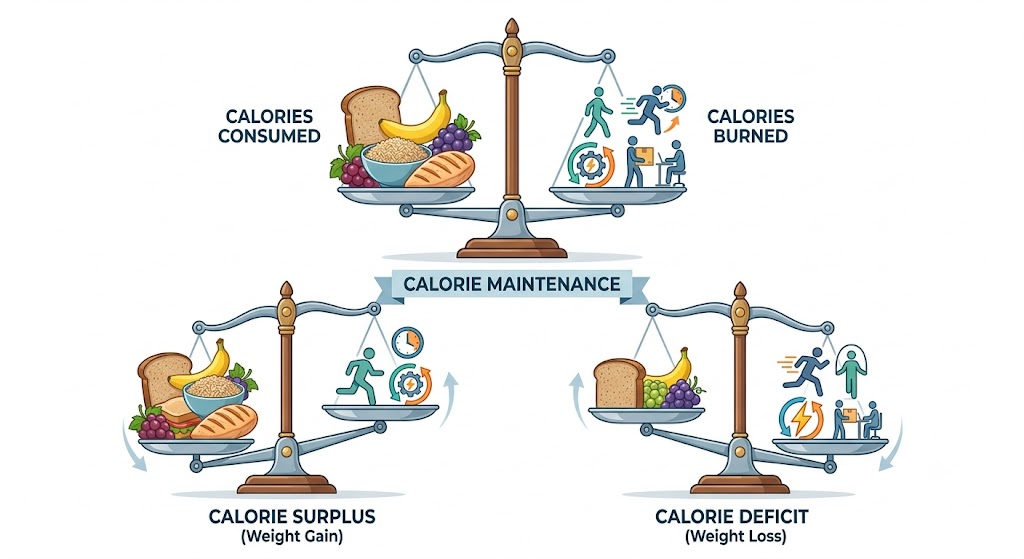
Energy balance is the relationship between the energy you take in in the form of calories consumed and the calories your body uses to function.
Let’s imagine that you have a two-pan scale:
- In one pan, you have all the energy you have consumed from proteins, carbohydrates, and fats.
- The other pan holds the energy your body needs to keep your heart beating, lungs breathing, and energy reserved for physical activity.
The Three States of Energy Balance
Calories for maintenance:
If both scales are equal, it means that your energy input and energy output are equal. This is good for maintaining a healthy body weight.
Surplus Calories:
When you consume more calories than your body needs, you are in a calorie surplus. Your body stores the excess calories as fat. Your “energy in” is higher than your “energy out.”
Calorie Deficit:
A calorie deficit is when you deliberately consume fewer calories than your body needs. To keep your body functioning, it starts burning stored fat, & you lose weight.
How to Calculate Your Calorie Deficit
Below are the methods to calculate your calorie deficit.
Step 1: Estimate Your Maintenance Calories
Your calorie needs are unique. Your age, sex, height, weight, and activity level determine your maintenance calorie needs. So one number cannot work for everyone.
Manual Estimation:
If you are moderately active, you can multiply your current body weight by 15 to estimate your daily calorie needs.
The BMR Method:
Another way is to calculate your Basal Metabolic Rate (BMR) first, then multiply it by your daily activity factor.
Male BMR: (10 × weight in kg) + (6.25 × height in cm) – (5 × age in years) + 5
Female BMR: (10 × weight in kg) + (6.25 × height in cm) – (5 × age in years) – 161
Apply Activity Multiplier: Multiply your BMR by 1.2 (sedentary), 1.375 (1–3 days of exercise), 1.55 (3–5 days), 1.725 (6–7 days), or 1.9 (extra active).
Note: The methods given above are helpful, but the best way is to consult a doctor or a nutritionist.
Step 2: Choose a Realistic Calorie Deficit
You can create a calorie deficit by consuming fewer calories than you burn. You can combine exercise and diet to lose weight faster.
Eat Healthy:
Choose foods that are rich in nutrients like whole grains, vegetables, fruits, and lean proteins.
Exercise:
Exercise at least 150 minutes daily and add two strength training sessions per week.
Safety First:
Do not cut your calories too aggressively. Weight loss is a slow, gradual process; the best you can hope to lose is one or two pounds per week. If you cut too many calories, it can slow down your metabolism, cause nutritional deficiencies, and lead to gallstones.
Step 3: Track Progress and Adjust
The number on the scale usually provides incomplete information. Sometimes, even when your body composition is improving, the scale doesn’t move.
Listen to Your Body:
If you experience difficulty sleeping, negative mood swings, you might be cutting too many calories.
Readjust your calorie deficit:
Sometimes when your body changes, your calorie needs change as well. So you might need to adjust your calorie deficit. Just make sure you are eating enough to keep your body functioning.
Note: If you have diabetes, check with your healthcare provider before changing your diet.
Foods That Help Stay in a Deficit
The following foods can help you with your calorie deficit.
Vegetables and Fruits:
Vegetables like spinach, broccoli, & asparagus contain lots of fiber and water. which makes you feel fuller for longer. Berries and apples are great for overcoming hunger pangs.
High-Protein Foods:
Protein is your best friend when you’re trying to lose fat. Eggs, chicken, turkey, fish, and lentils are great sources of protein.
Fiber-Rich Whole Grains
If you want to avoid over eating then high fiber foods like oats, quinoa, and black beans are a great choice.
Healthy Seeds:
Chia seeds expand when watered, which helps you feel satisfied for a longer period.

Common Beginner Mistakes
1. You’re Eating More Than You Realize
It’s very easy to underestimate portions. Sauces, cooking oils, drinks, quickly add up and erase your deficit. Use a digital kitchen scale and track everything.
2. You’re Overestimating Your “Burn.”
Fitness trackers often inaccurately measure calories. Walking your dog doesn’t burn as many calories as you might think. The point is, sometimes you overestimate how many calories you are actually burning.
3. Your “Maintenance” Calculation is Off
Most online formulas are just general predictions based on age, height, and weight. If you have less muscle mass than average, these formulas might leave you eating at maintenance rather than in a deficit.
4. Liquid Calories
Smoothies, coffees, juices, and alcohol are packed with calories, often including high amounts of sugar and carbs. These can easily push you out of a deficit without you feeling full.
5. “Cheat” Days
If you are diligent during the week but “go all out” on the weekends, those extra calories can completely cancel out your hard work from the previous days. Consistency is key.
FAQs:
1. How much calorie deficit do I need to lose weight?
A common and safe calorie deficit is around 500 calories per day. This usually results in about 1 pound (0.45 kg) of weight loss per week, depending on your body and activity level.
2. How do I know my maintenance calories?
You can estimate maintenance calories using your body weight, activity level, or formulas like the BMR method. However, these are only estimates, and your real maintenance level may vary based on your lifestyle.
3. Can I lose weight without exercise if I’m in a calorie deficit?
Yes, weight loss is possible through diet alone if you maintain a calorie deficit. But if you combine it with exercise, it can improve your metabolism and health.
4. Why am I not losing weight even in a calorie deficit?
This happens due to tracking calories inaccurately. Hidden calories, like calories from oil and drinks, can contribute to weight gain. Inaccurately measuring calories burnt by exercise can be another factor.
5. Can cheat days ruin a calorie deficit?
Yes, frequent or uncontrolled cheat days can cancel out your weekly calorie deficit. A single high-calorie day can erase several days of progress if not balanced properly.